A Design for Manufacture Journey
Background
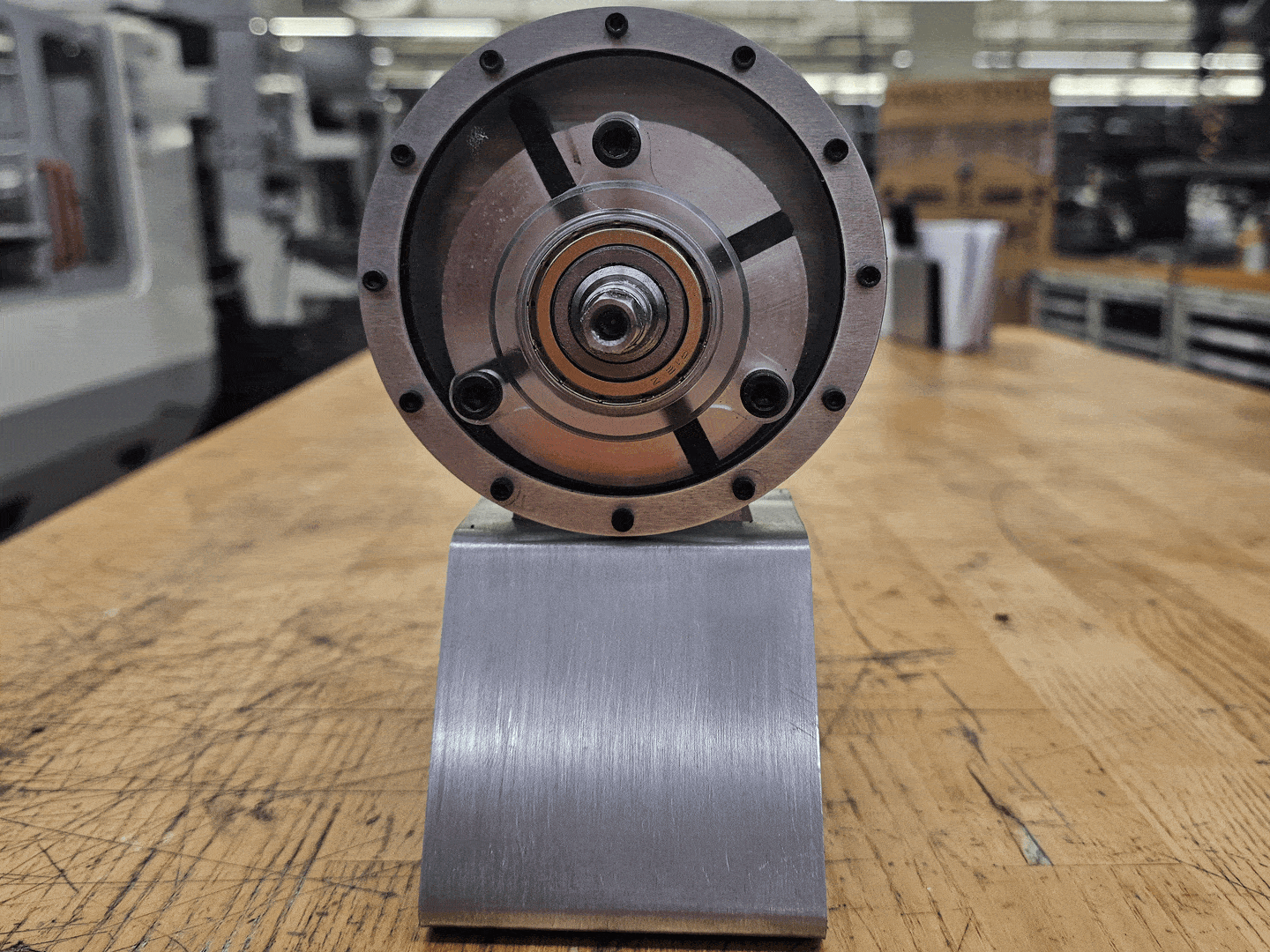
This Rotary Vane Pump serves multiple purposes. For one, of course, it can pump fluids; on top of that, however, it is both an exploration of the variety of manufacturing techniques available to students at BU and an object lesson in how important design for manufacture is.
The pump was designed by our professor to achieve both of these goals. As a result, it is complex, requiring a total of 60 individual parts, many of which must hold tolerances within 0.001 inch for the pump to work. On top of that the pump is difficult to assemble, requiring careful alignment by hand and much nudging and adjusting for the final functional fit.
In this way, we were not only taught how to make a pump, but in many ways how not to design one. I then took the learnings from this painful process and applied them to my own pump design, which mitigates or eliminates many of the listed pain points.
All told, this pump represents 3 months of work using manual and CNC mills, lathes, laser cutters, waterjet cutters, aluminum castings, and sheet metal brakes in BU’s Engineering and Product Innovation Center.
The Pump

This is the exploded view of the physical pump we built. Nearly all the parts are custom made with a variety of processes.
1 – Housing
The outer housing perimeter was cut from 1″ thick aluminum plate on a CNC mill, then the inner bore was roughed with a hole saw. This left the inner slug available to make the rotor (4). The Housing was then mounted to a lathe with a 3 jaw chuck and faced on both sides bore being precision bored to final internal diameter and finally turned to final thickness. Care was taken to manage the burr such that the inner sealing surface of the housing was smooth and burr-free without breaking the sharp corner of the housing, which would cause a poor seal in the final pump. Finally, two port holes were drilled and tapped with 1/4″ NPT threads to accept inlet and outlet hose barb fittings (15).
2 – Vanes
The vanes were cut from 1″x1/4″ Delrin flat bar stock on a manual mill. They were actually the last parts cut, requiring careful custom fitting for a snug final fit. The process was slow and frustrating, teaching us the importance of designs that are both tolerance-aware and easy to assemble. The vanes needed to fit smoothly into the slots of the rotor (4), and touch the front and rear plates with
3 – Shaft
The shaft was turned from 3/4″ polished steel rod. Most of the shaft was left as is, with just a face and chamfer on the back side and a shoulder on the front side all turned on the manual lathe. Then, 6 flats we machined on the mill to make a hex that fits in a 3/8″ socket for turning the pump with a hand drill.
4 – Rotor
The rotor was machined from the slug removed from the housing in a multi-step process, First, it was chucked in the 3-jaw and given enough smooth outer dimeter to be flipped around and faced off. It was then flipped again and turned to final thickness, then drilled and reamed to just a bit smaller than 3/4″. The rotor was then sweat fit to the shaft(3) before being chucked back up into the lathe for final outer diameter, then into the 4-axis CNC mill for machining the slots with a square end mill.
5 – Rear Plate & 8 – Front Plate
The faceplates were both milled with our 3 axis CNC machine. The rear plate was machined in aluminum in 2 workholdings with a a custom soft jaw for the machine vise, while the faceplate was cut from cast acrylic in a single operation using fixture tape on the flat machine surface.
7 – Gasket Seal
The gaskets were cut from 0.03″ paper gasket material using a laser cutter for a precision fit.
12 & 13 – Bearing Blocks
The rear bearing holder was first cast in Aluminum with a petrobond sand negative, formed from a 3D printed positive mold. The castings were cut from the sprue with a band saw, held in a soft jaw vice for machining of precision surfaces.
The front bearing block was CNC machined from cast acrylic. After milling, it was lapped on both faces with sandpaper, then acrylic polish to a transparent sheen.
17 – Washer Ring
A load-spreading washer was cut with a waterjet machine from 1/32″ aluminum sheet to protect the acrylic faceplate from stress fractures.
19 & 21 – Stand
The sheet metal stand was cut with a waterjet from 1/32″ aluminum sheet, bent into position with a brake, and pop riveted together for a clean finish.